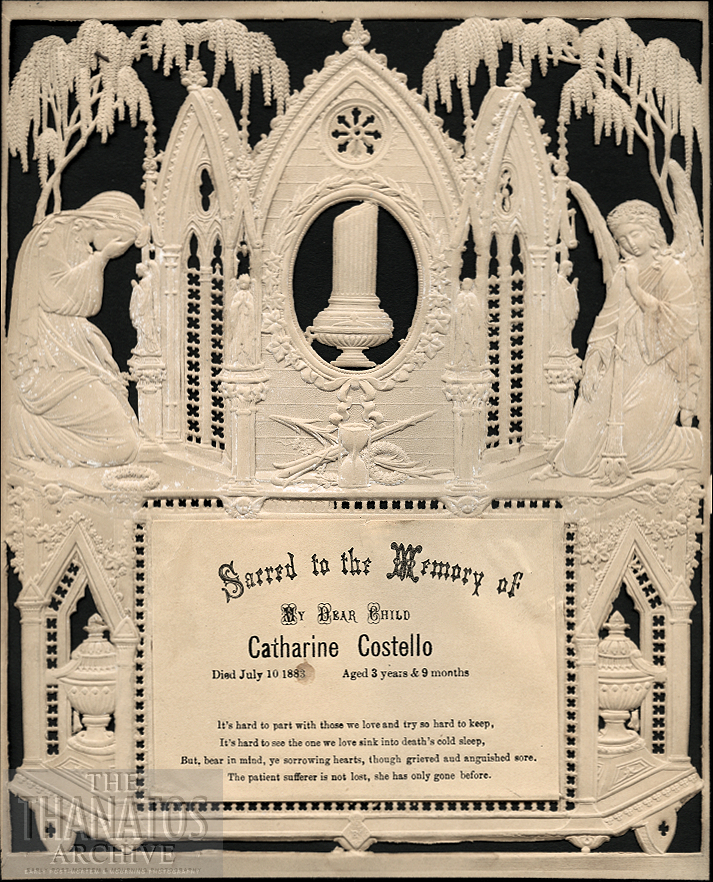
Large (12″ x 10″) memorial die cut for Catharine Costello, a little girl who died at 3 years and 9 months in Lowell, Massachusetts in 1883. Her cause of death was “Paralysis of the heart”. This die cut features many classic mourning symbols, including a broken pillar, draped urn, hourglass, willow trees, and more. Die cut memorials were popular in the middle-to-late 19th century; they are made of heavy embossed paper with cut out sections. The piece shown here has a piece of black paper behind it. Visit the Thanatos Archive to view more of our post mortem and memorial collection. Membership options @ http://www.thanatos.net/membership
Tag Archives: suicide note
Recent Archive Updates
Some recent updates, and more to be scanned.
Current members, log in here.
… Or become an Archive member here.
Schoolhouse Morgue / Johnstown Flood, 1889
“The Great Flood”, Johnstown, PA, 1889, 2200+ dead.
An apocalyptic scene showing the Millvale School surrounded by a desert of sand, mud and debris several feet deep. Because it was one of a handful of buildings in the immediate area strong enough to survive the flood, it was turned into a temporary morgue; the men and horses are shown delivering coffins and bodies of victims to the side entrance.
* We have several Johnstown Flood related images in the collection, including a post-mortem cabinet card of a little girl who was found in the river and never identified.
Thanatos Archive membership options @ http://www.thanatos.net/membership
Axe Murderess, 1871 (Blog Exclusive)
Original CDV from our collection showing George Campbell, his wife Phoebe, and their orphaned children. Phoebe was found guilty and hanged for the murder. The full story, from Wikipedia, follows:
Phoebe Campbell (c. 1847 – 20 June 1872) was a Canadian woman who was hanged for the murder of her husband. Campbell had alleged that on the morning of July 15, 1871, in Thorndale, Middlesex County, Ontario, two black-faced men broke into George and Phoebe’s log cabin home and brutally hacked George to death with an axe because he refused to hand over some money. They had attempted to use a gun which misfired. During the investigation, six local men were arrested, including Thomas Coyle, who was George’s farmhand. Doubt about Phoebe’s innocence arose rapidly as she was seen talking with Coyle, she also seemed to have done nothing to help save her husband as he was being murdered, also she seemed very unemotional following the funeral for George. A coroner’s autopsy also showed that indeed George was murdered by Phoebe and Coyle. “I don’t care. I’m innocent and I don’t care.”, Phoebe stated.
She then accused Coyle of the murder then quickly changed her mind then accused her cousin. Phoebe’s murder trial began on April 1, 1872, with much public interest. Phoebe accused George of having an affair with her cousin’s wife. During the trial, the crown prosecutor produced a letter which stated, “I never shall say you done any such thing again—if I have to die for it.” When asked why she changed her testimony, she claimed the ghost of her late husband visited her and declared her and Coyle innocent. The crown prosecutor responded, “You can hardly expect anyone to believe such nonsense!” After the trial, the jury took just one hour to reach a guilty verdict.
Phoebe then sobbed as the judge sentenced her to hanging. She later confessed that she and Coyle murdered George so they could marry. Coyle did go to trial for his crime but was acquitted. He later moved to England. She was hanged on June 20 at the age of 25 and was again said to be emotionless as she was about to be hanged, holding a lace handkerchief in her hand until after she died.
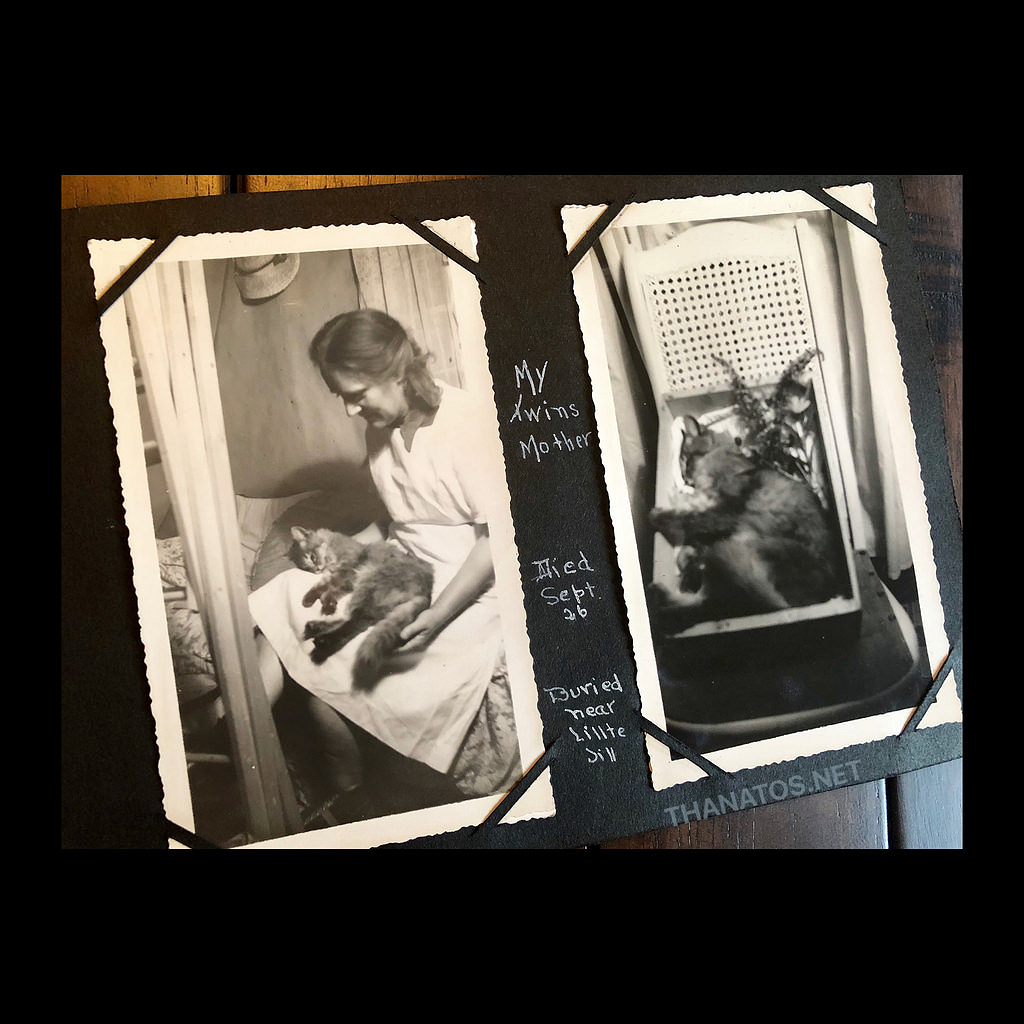
Woman with Pet Cat & In Casket (Blog Exclusive)
1930s snapshots. Thanatos Archive membership options @ http://www.thanatos.net/membership
Photo 2 of 2, St. Louis Boy (Blog Exclusive)
Close-up view of the St. Louis boy, quarter-plate daguerreotype, circa 1855.
Another post mortem photo of this same boy, a full-length shot of him on a covered table, can be viewed in our members section, here: Image #3278 (Archive membership required, see link below).
Please consider subscribing for access to the collection. Info at: http://www.thanatos.net/membership
Opera House Fire, 1908, Blog Exclusive (Graphic Image Warning)
Four 1908 real photo postcards documenting the Rhoads Opera House fire and aftermath. From Wikipedia:
The Rhoads Opera House Fire occurred on Monday evening, January 13, 1908 in Boyertown, Pennsylvania. The opera house caught fire during a stage play sponsored by nearby St. John’s Lutheran Church. The fire started when a kerosene lamp being used for stage lighting was knocked over starting a fire on the stage. In short order the spreading fire ignited a mixture of lighting gas & oxygen from a malfunctioning stereopticon machine being used to present a magic lantern show at intermission. Audience members waited for the fire to be extinguished by theatre personnel, wasting the precious minutes they needed to escape safely.
The stage and auditorium were located on the 2nd floor and the few emergency exits available were either unmarked or blocked. Two fire escapes were available but were only accessible through latched windows whose sills were located 3 & 1/2 feet above the floor. Of the approximately 400 men, women, and children either in attendance or associated with the performance of the play 171 perished in various ways as they tried to escape the conflagration. In the panic to escape many were crushed in the narrow main entrance stairway as well as against the jambed main exit swinging doors of the 2nd floor auditorium. In a few instances entire families were wiped out. One firefighter John Graver, was also killed while responding to the incident.
Thanatos Archive membership options @ http://www.thanatos.net/membership
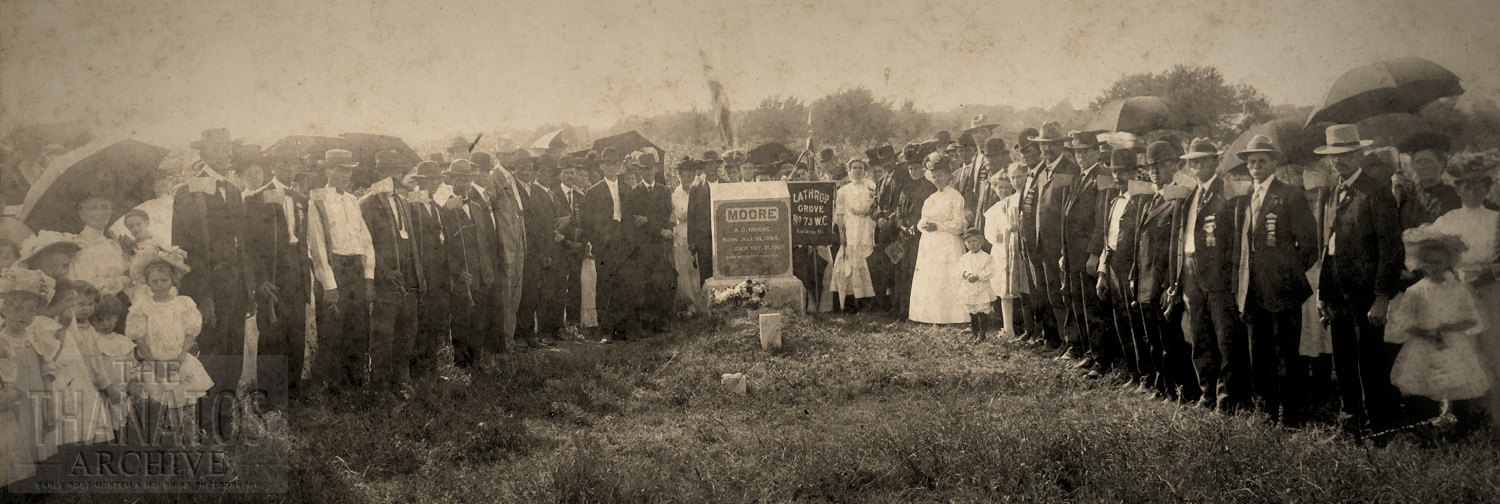
Dedication of Tombstone, Woodmen of the World (Blog Exclusive)
Fellow Woodmen of the World members and family of R.D. Moore (1884-1907) gathered to place his headstone, which was paid for by Moore’s fraternal Wow lodge. The lodge’s banner is being held up next to the marker, and members are wearing black mourning ribbons, mostly likely printed with Moore’s name.
The grave is located in Lathrop Cemetery in Lathrop, Missouri.
Please consider becoming a supporting member of The Thanatos Archive! Info at: http://www.thanatos.net/membership
Four Sisters in Mourning
Sisters in mourning, Coventry, England, circa 1862.
Become a Thanatos Archive member at: http://www.thanatos.net/membership
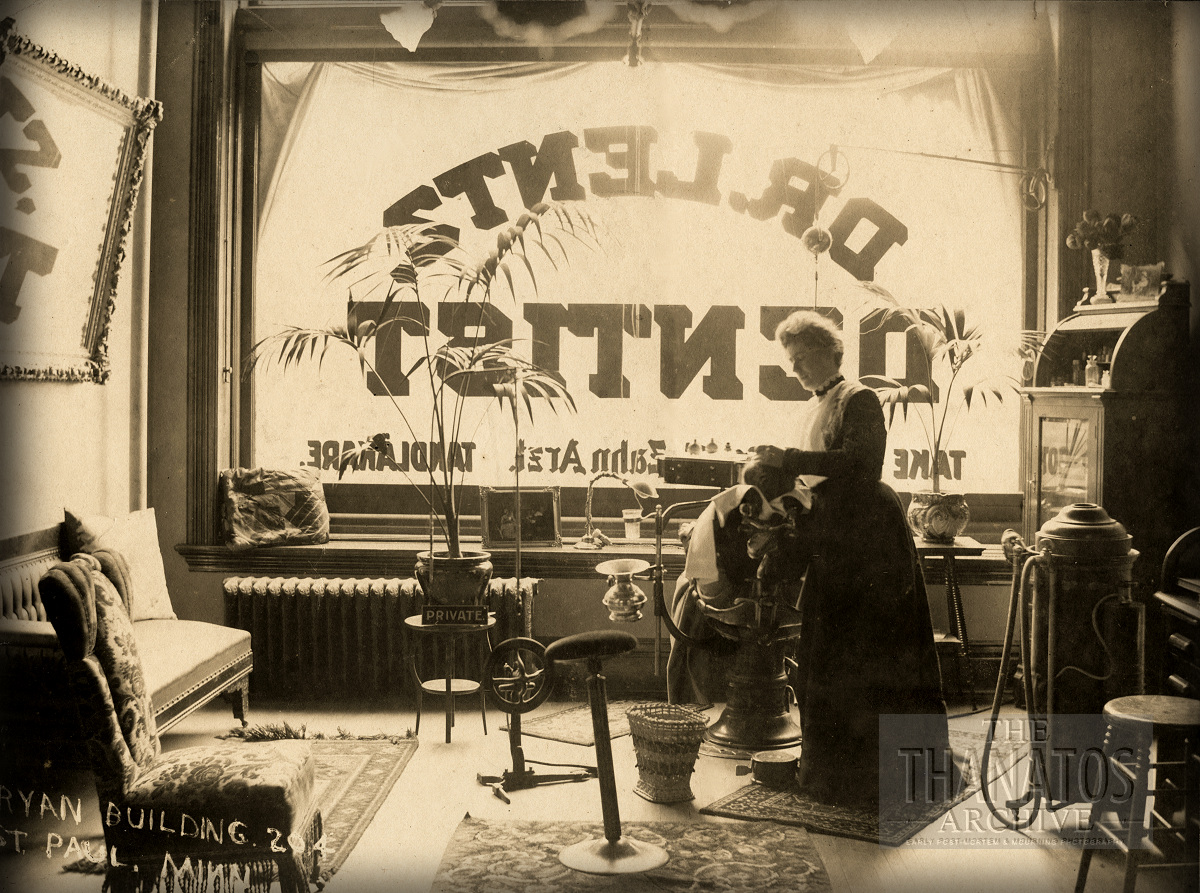
Lady Dentist, “Pretty & Popular” (Archive Image #EXCLD)
St. Paul dentist Olga Lentz, with a patient. St. Paul, Minnesota, circa 1890.
Olga was one of the first (if not the first, need to verify that) lady dentists in Minnesota!
This is a wonderful photo of her at work. Below is the complete text of an 1889 newspaper article about her.
A GIRL DENTIST.
Who is Pretty and Popular, and Has an Income of $5,000 a Year.
She fills a Tooth for a Reporter, and Chats Pleasantly About Her Business.
A dentist is no longer a king of terrors. She is a queen of beauty, says the New York Morning Journal. How pleasant to see a sweet, delicate, girlish face bent over yours as you lean back in the fatal chair of torture! How delightful to gaze up into tender blue or black eyes, and feel that soft tendrils of hair are sweeping your brow like a summer zephyr!
It is any wonder that young lady dentists are successful, and that their number is constantly on the increase? New York supports several, and it was to one of the number that I went not long ago for advice on the subject of a tooth.
The house to which I was directed was a small high-stoop, brown stone dwelling, with the dentist’s name on a silver plate. A neat, white-capped handmaiden opened the door and I was ushered into a pretty parlor in which dainty scarfs and bits of bric-a-brack, comfortable chairs and easels with large photographs upon them made a charming nook in which to meditate over the approaching terrors of the dentist’s chair.
“Will you walk this way?” said a sweet voice.
A pretty, fluffy blonde head was thrust between the folding doors at the back of the drawing-room. I complied with the request and was soon seated in a big chair opposite a high window.
It gave me a new and pleasurable sensation to feel those white and dainty fingers entering my mouth and adjusting a little round mirror for examination. They seemed good enough to eat. And when the soft cheek nearly touched mine it was all I could do to restrain myself from jumping up and hugging the lovely young dentist on the spot.
“Let me know if I hurt you,” said the dentist soothingly, as she began to scrape away at the offending tooth.
I was so fascinated by the sight of her pretty, deft wrist directly under my nose that I could have borne any amount of torture without a murmur. There were muscles like steel in that pretty wrist, by the way.
“What led you to become a dentist?” I asked, as the charming operator turned away for a bit of cotton.
“Love for the work,” she replied. “Teeth have always had a charm for me. When I was a child I was always examining cats’ and dogs’ teeth. I filled a tooth for a pet dog of my own once and every member of my family came to me when anything was wrong with his or her dental organs. I used to prescribe for toothache for half the neighborhood in which I lived in Western New York.”
A bit of perfumed cotton went into my sore tooth and stopped conversation for the moment.
“Where did you learn dentistry?” I asked, as the sweet young dentist (she was not more than 25) wiped her hands with a soft sponge dipped in lavender water.
“I graduated from the dental college at Philadelphia,” replied the young lady. “The New York College of Dentistry does not, you know, admit women. I had to go to Philadelphia to study, but I returned to New York to practise, because the field is wider here. I have been a dentist for five years, and my practise has steadily increased, so that I now make about $5,000 a year by my profession.”
I stole a glance at the slight wrists which looked so incapable of grappling with molars.
“Do you pull teeth as well as fill them?” I asked.
“Not often,” said the dentist, giving a shake to her cream-colored India silk draperies that were caught in the arm of the chair. “It would not pay me to strain my wrist for a sort of work that can be done by almost anyone. There is nothing artistic in the process of extracting teeth – any bungler can do it. I pull teeth for children more often than for grown people. Milk teeth are no trouble to pull.”
“What sort of people do you number among your customers?”
“All sorts – ladies, children, a few gentlemen, and a large number of school-girls of the strong-minded, independent sort. Most of my clients are recommended to me by others. I do not, as a rule, care to treat strangers, especially men.”
“Then why did you treat me?” I inquired.
The blush rose-tint on the fair face deepened and there was a merry twinkle in the blue eyes.
“Because Mary, that’s my maid, gave a good report of you. We dentists have to use tact and discrimination as much as other people.”
With this the young lady handed me my bill, which she had been making out. I paid it and put the receipted document in my pocket as carefully as if it had been a love letter, and thus ended my first visit to the charming girl dentist, but it was not my last.
.
Photo from the vintage medical/dental/anatomy section of our archive. Not yet a Thanatos Archive member? Please consider subscribing at: http://www.thanatos.net/membership