Cherry Mine Disaster

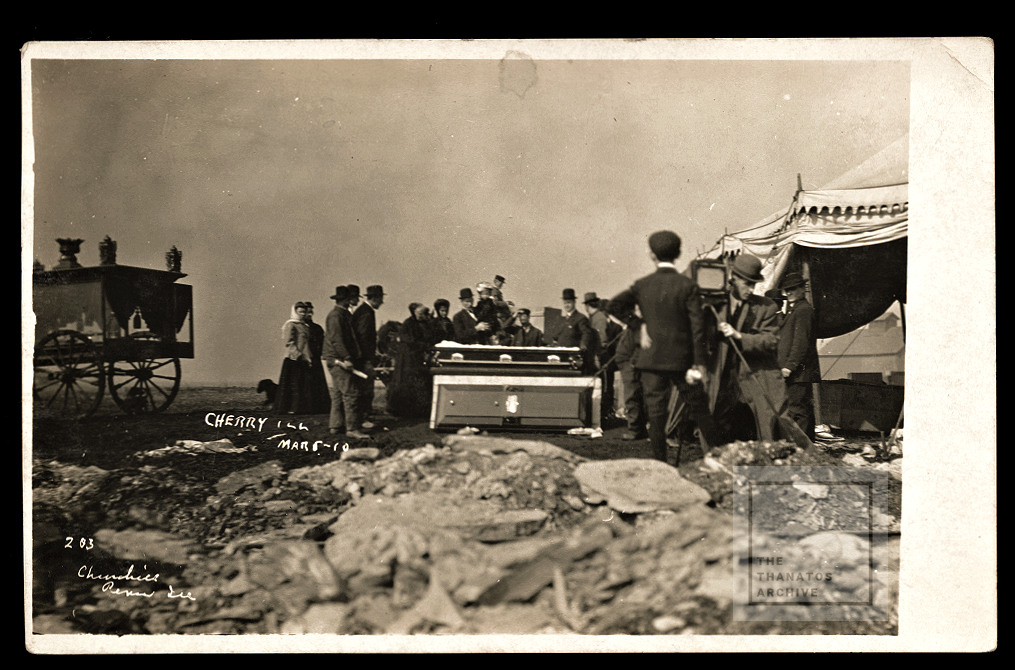
Relatives at an outdoor morgue view the body of a young man who died in the Cherry Mine disaster. He had worked in the mine only two days.
The doors of a funeral hearse are partially visible on the left.

On Saturday, November 13, 1909, like most days, nearly 500 men and boys, and three dozen mules, were working in the mine. Unlike most days, an electrical outage earlier that week had forced the workers to light kerosene lanterns and torches, some portable, some set into the mine walls. 259 men and boys died.

We have several Cherry Mine related images in our Archive. If you are a Thanatos.net subscriber, just type Cherry Mine into the search box to view them. Not yet an Archive member? Please review our membership options here.

Dear Brother Nelson

[Letter addressed to Robt. N. C. Mount, Esq, Monticello, Jasper Country, Georgia]

New York, Jan’y the 16th 1841

Dear Brother Nelson, [Robert Nelson Mount]

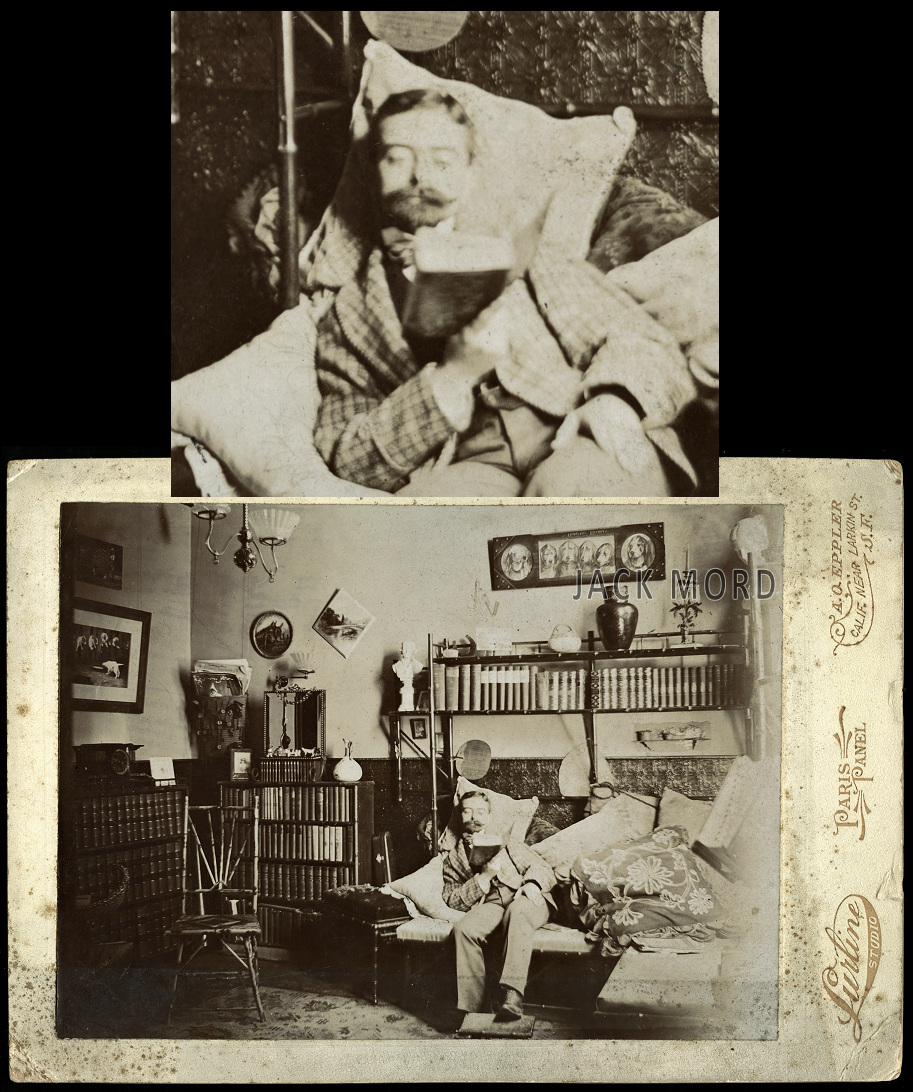
If you recognize the features of the enclosed sketch, you will doubtless be somewhat prepared fro the melancholy intelligence I am about to communicate – our dear Brother Henry is no more, he died on Sunday the 10th of Jan’y at 1/2 past eleven o’clock A.M. and was buried on the Tuesday following.

I was not at Stony Brook when he died, but arrived there in time to attend the funeral – was there the week before and as I too sensibly felt, parted with him for the last time. Altho a great sufferer, he bore his illness with patience, and died most happily.

He told Mary [wife Mary Bates Ford] he was dying – desired there should be no commotion in the room – said he should like to live on account of his family, but as it was God’s will he should die. He was willing to go – desiring his children to be brought to the bedside he shook hands with them all and then kissed them – In like manner he parted with his wife and the rest of the family, saying to Mother “Kiss me once more and don’t be distressed on my account, I am willing to go”. A quarter of an hour after he died, looking as if he had lain down to pleasant dreams, the sketch of him was taken after death by Brother William [William Sidney Mount] and is a strong resemblance of him as he then appeared.

The family are all well considering the fatigue both of body and mind through which they have so recently passed. Mother’s health is at best but feeble – she talks a great deal of you. Now Brother Henry is gone, she will doubtless be more anxious to see you than ever – do come home as soon as it is consistent with your feeling and arrangements of business – I would not advise to your injury, but can assure you we should all rejoyce once more to see you among us, to fill up the void which Death has made in our family circle. I have a thousand things to say to you, but have not room to spare. William will write you in a few days. I have always felt a deep interest in your welfare, though I have not written you before since your absence, and I regret the first should be the bearer of such sorrowful tidings.

Yours affectionately,
S.A. Mount [Shepard Alonzo Mount]

** Henry’s deathbed portrait is available in the subscription section of our website at www.thanatos.net. Current subscribers, can click here to go directly to the image.

Grave, Letter, Obituaries of Young Siblings (Archive Image #3317)

The children’s obituary and handwritten letter.


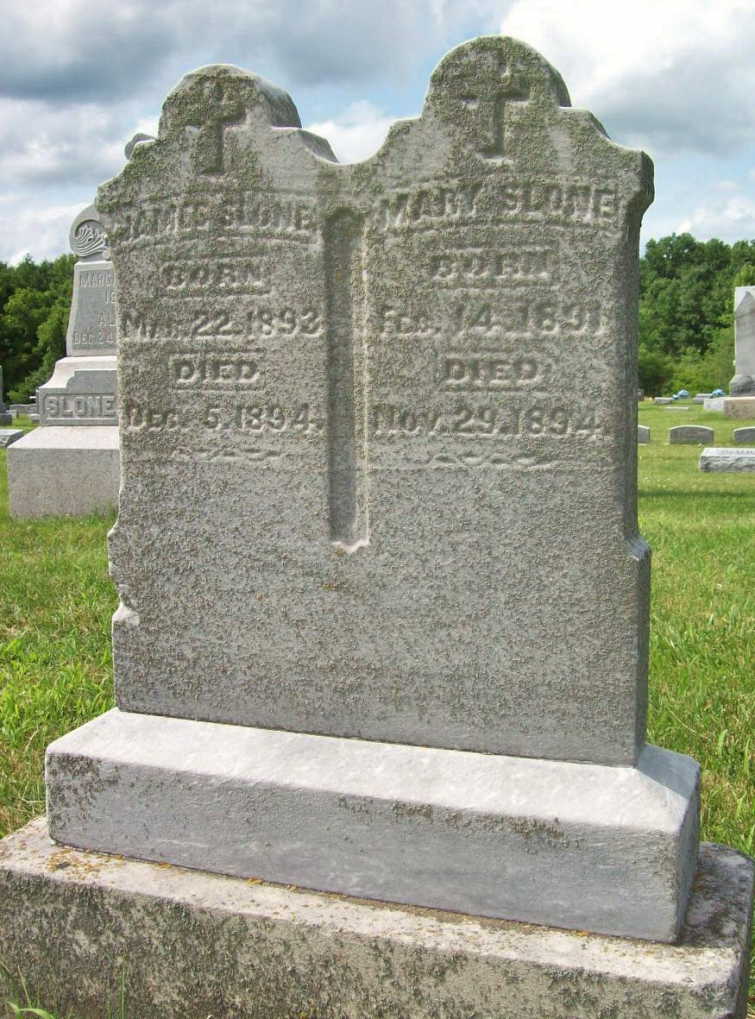
Shared grave marker of children who died within a few days of each other, one from burns, the other from measles.

The children’s post mortem cabinet card photos can be viewed in the subscription section of The Thanatos Archive:

Mary and Jamie’s Death Photos (You must be a Thanatos Archive member, if not, review membership link below)

Subscriptions @ http://www.thanatos.net/membership

Large Mourning Die Cut (Blog Exclusive)

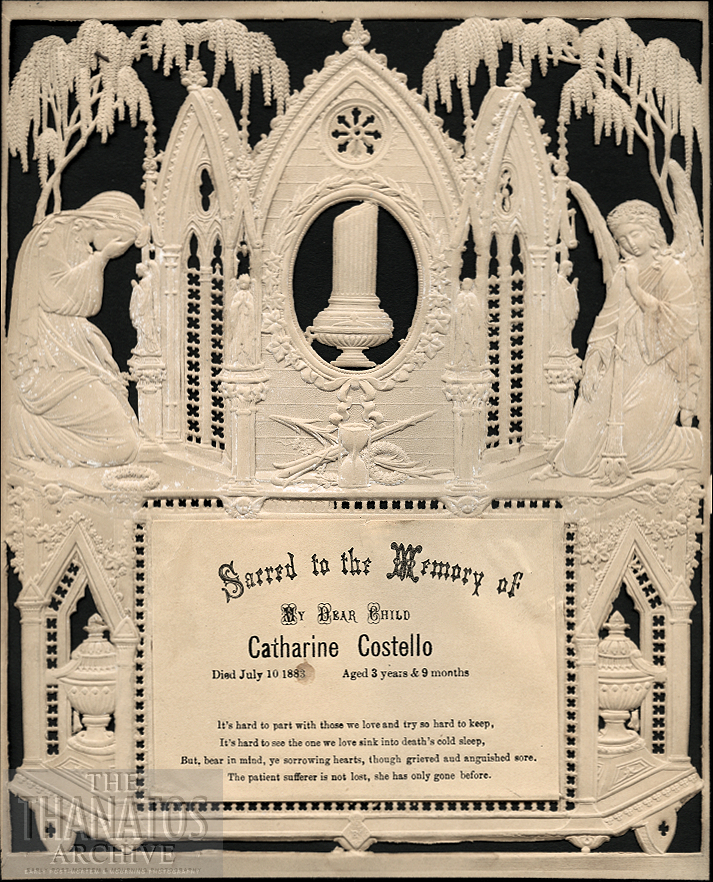
Large (12″ x 10″) memorial die cut for Catharine Costello, a little girl who died at 3 years and 9 months in Lowell, Massachusetts in 1883. Her cause of death was “Paralysis of the heart”. This die cut features many classic mourning symbols, including a broken pillar, draped urn, hourglass, willow trees, and more. Die cut memorials were popular in the middle-to-late 19th century; they are made of heavy embossed paper with cut out sections. The piece shown here has a piece of black paper behind it. Visit the Thanatos Archive to view more of our post mortem and memorial collection. Membership options @ http://www.thanatos.net/membership

Schoolhouse Morgue / Johnstown Flood, 1889


“The Great Flood”, Johnstown, PA, 1889, 2200+ dead.

An apocalyptic scene showing the Millvale School surrounded by a desert of sand, mud and debris several feet deep. Because it was one of a handful of buildings in the immediate area strong enough to survive the flood, it was turned into a temporary morgue; the men and horses are shown delivering coffins and bodies of victims to the side entrance.

* We have several Johnstown Flood related images in the collection, including a post-mortem cabinet card of a little girl who was found in the river and never identified.

Thanatos Archive membership options @ http://www.thanatos.net/membership

Axe Murderess, 1871 (Blog Exclusive)


Original CDV from our collection showing George Campbell, his wife Phoebe, and their orphaned children. Phoebe was found guilty and hanged for the murder. The full story, from Wikipedia, follows:

Phoebe Campbell (c. 1847 – 20 June 1872) was a Canadian woman who was hanged for the murder of her husband. Campbell had alleged that on the morning of July 15, 1871, in Thorndale, Middlesex County, Ontario, two black-faced men broke into George and Phoebe’s log cabin home and brutally hacked George to death with an axe because he refused to hand over some money. They had attempted to use a gun which misfired. During the investigation, six local men were arrested, including Thomas Coyle, who was George’s farmhand. Doubt about Phoebe’s innocence arose rapidly as she was seen talking with Coyle, she also seemed to have done nothing to help save her husband as he was being murdered, also she seemed very unemotional following the funeral for George. A coroner’s autopsy also showed that indeed George was murdered by Phoebe and Coyle. “I don’t care. I’m innocent and I don’t care.”, Phoebe stated.

She then accused Coyle of the murder then quickly changed her mind then accused her cousin. Phoebe’s murder trial began on April 1, 1872, with much public interest. Phoebe accused George of having an affair with her cousin’s wife. During the trial, the crown prosecutor produced a letter which stated, “I never shall say you done any such thing again—if I have to die for it.” When asked why she changed her testimony, she claimed the ghost of her late husband visited her and declared her and Coyle innocent. The crown prosecutor responded, “You can hardly expect anyone to believe such nonsense!” After the trial, the jury took just one hour to reach a guilty verdict.

Phoebe then sobbed as the judge sentenced her to hanging. She later confessed that she and Coyle murdered George so they could marry. Coyle did go to trial for his crime but was acquitted. He later moved to England. She was hanged on June 20 at the age of 25 and was again said to be emotionless as she was about to be hanged, holding a lace handkerchief in her hand until after she died.